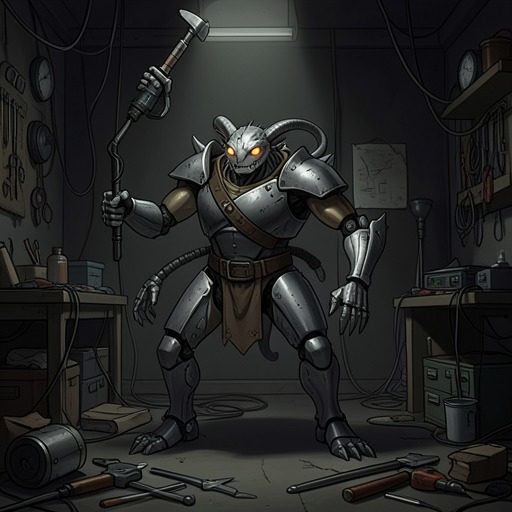
Eaters
The Legend of William OhEaters are among the most disturbing manifestations of survival’s collapse in The Tower: creatures that hunt humans for food after people have abandoned the last shred of their humanity. Their usual association with the upper floors makes them more than a routine monster encounter. They embody a terrible possibility within the Climber system itself, in which scarcity and confinement can transform people into the very predators future Parties fear.
Origin and Conditions
Eaters are said to originate from human beings trapped on an upper Floor for months without access to a Key Site. The upper floors provide no vegetables or game meat, and when regular supplies fail, hunger can drive a Party to eat its weakest members first. Those who commit this act and surrender their remaining humanity eventually succumb to Miasma, becoming monsters that hunt humans forevermore.
The account is presented as a story rather than confirmed doctrine. Will explicitly qualifies it as “Or at least, that was the story,” leaving the precise relationship between cannibalism, Miasma, and Eater transformation uncertain. Even so, the tale establishes a grim chain of cause and effect: a closed environment produces hunger; hunger produces violence within the Party; and violence produces a creature no longer recognized as human.
Encounters and Threat
Will first confronts the idea of Eaters through a scene of physical captivity. He awakens hanging upside down from a meat hook, his legs bound together, surrounded by hollowed-out human torsos. The bodies have been stripped like butchered animals, with heads and entrails removed and pieces of meat missing; a hand and a rib remain as stark signs of what has been consumed. The scene turns the rumor into an immediate bodily danger, because Will may not merely be imprisoned but stored as food.
The danger is repeated when Will must cross a field crawling with Kaith warriors. He chooses to sprint through the Kaith rather than risk becoming “a Will Sandwich for some Eaters,” treating escape from the insectlike defenders as the less frightening alternative. The contrast gives Eaters an unusual narrative power: even a battlefield filled with hostile Kaith can seem preferable to the possibility of being captured by human-eating monsters.
The 2nd-Floor Contradiction
The presence of Eaters on the 2nd Floor troubles Will because the conditions he associates with their creation are not present there. The floor still has goats and birds, along with regular wheat shipments from the lower Floors. It is therefore not an obvious starvation zone, and Will questions why an Eater would be there at all, briefly considering whether one might have moved downward simply to find easier prey among inexperienced Climbers.
That discrepancy makes the Eaters more unsettling rather than less. If the accepted story is correct, their appearance suggests either that an Eater has migrated beyond its expected territory or that the story omits an essential part of their origin. The 2nd Floor’s functioning food supply also prevents the creature from being explained away as the inevitable product of local famine. Its presence instead exposes the limits of the knowledge available to Climbers.
Boundary Between Human and Monster
Eaters occupy a contaminated boundary between person and predator. Their defining horror is not only that they consume human bodies, but that they are believed to have once belonged to the same social world as their victims. The meat hooks and stripped torsos make the transformation legible through material remains: the human body becomes inventory, while the former human becomes the agent of further consumption.
The book places this horror beside other unstable boundaries. Loth’s barrel of soil houses dozens of insect species under his effortless control, and a hooded figure in a leather cloak is revealed to be a “Saboteur” beside a barrel nearly as large as itself. Later, the Tangled are recognized as humans produced by an Ability rather than natural creatures. Against these examples, Eaters represent a darker form of conversion: not a controlled skill or unusual body, but a social and environmental breakdown that makes humanity itself difficult to recover or even define.
Narrative Function and Significance
Eaters turn survival strategy into moral and existential horror. Climbers must manage routes, food, levels, acclimation, and the danger of advancing too quickly; the warning about following a bus toward a higher Floor therefore carries more than tactical significance. A higher Floor may offer progress, but it may also bring isolation, scarce supplies, and conditions in which a Party can cease to be a Party at all.
Their limited appearances are effective because the threat is revealed in stages. The meat hooks provide the visible horror, the stories of upper-floor starvation supply the implied history, and the apparently impossible 2nd-Floor encounter preserves uncertainty. Eaters thus function both as predators and as a warning about what the Tower can make of people. They are not simply creatures waiting in dangerous territory; they are the remembered endpoint of hunger, abandonment, and the decision to treat another human body as a resource.